
Inventory control is the difference between an order that ships the same day and a customer who gets an "out of stock" email. It's the day-to-day work of knowing exactly what's in your warehouse, where it sits, and when to reorder, before a gap becomes a lost sale or a corner fills up with dead stock.
Getting this right is the quiet engine behind every reliable shipment. This guide covers what inventory control actually is, the main types and methods, a simple process to follow, and the best practices that keep stock accurate as you grow.
TL;DR
Inventory control keeps existing stock accurate. It manages what's already in your warehouse, not the wider supply chain.
Inventory control is the warehouse-floor work; inventory management is the broader sourcing-to-customer picture.
Two core system types do the tracking: periodic (manual counts at set intervals) and perpetual (continuous, real-time data).
Proven methods carry the load: ABC analysis, economic order quantity, reorder points, safety stock, FIFO/LIFO, and cycle counting.
A repeatable process beats guesswork; receive, store, track, count, reorder, and review.
Good practices protect cash and customers. Accurate counts mean fewer stockouts, less dead stock, and faster fulfillment.
What Is Inventory Control?
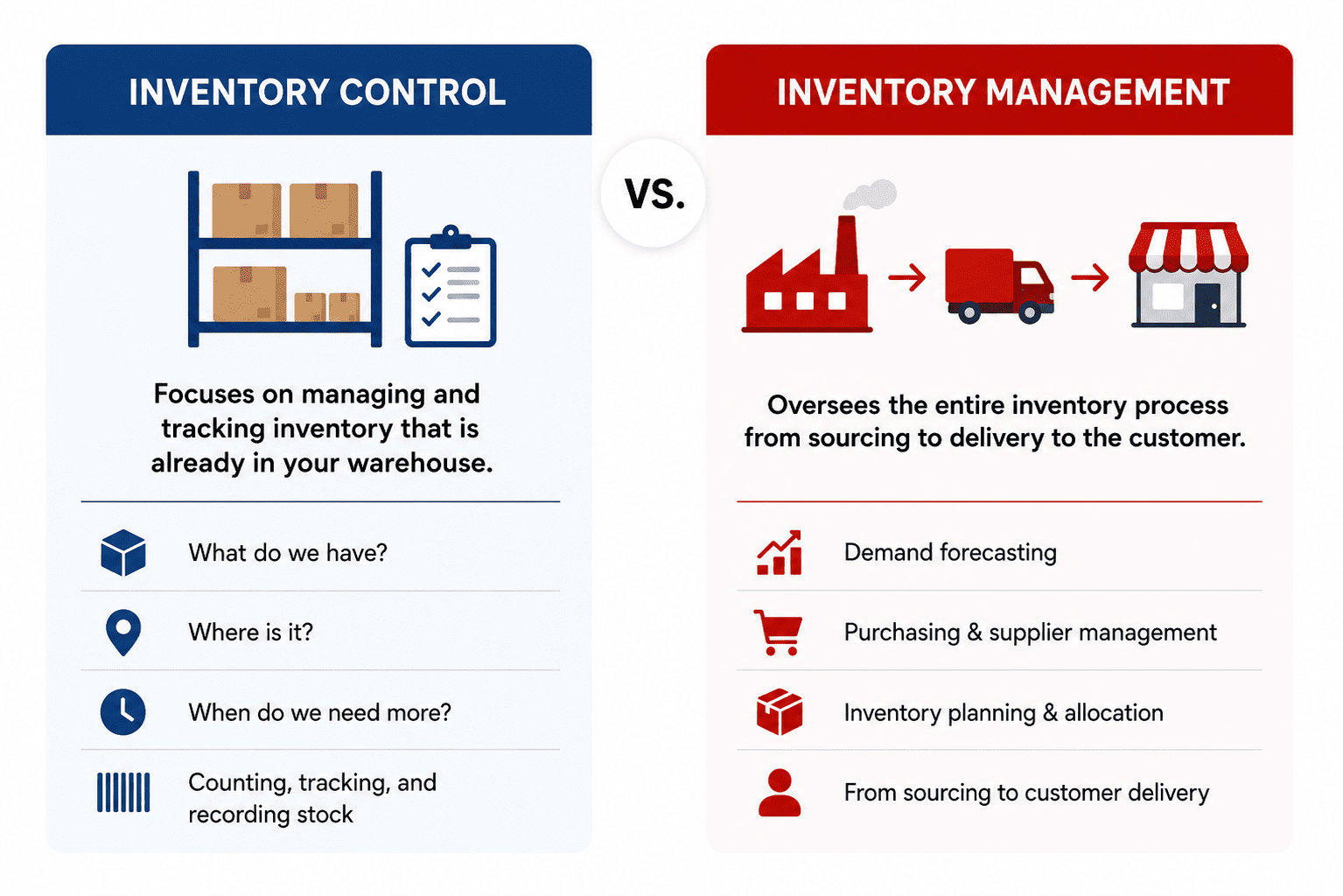
Inventory control is the set of activities, systems, and procedures a business uses to keep the right amount of stock on hand and accurately recorded. In plain terms, it answers the three questions every warehouse lives by: What do we have? Where is it? When do we need more? It's the practical, hands-on side of managing inventory once it's actually in the building.
➡️ Inventory control regulates what's already in your warehouse; the counts, the locations, and the movement of goods, so your on-hand numbers match physical reality.
Inventory Control vs Inventory Management
Here's a distinction worth getting straight, because the two terms get mixed up. Control focuses on the stock physically sitting in your facility right now. Inventory management is the wider discipline: it covers demand forecasting, purchasing, supplier relationships, and how goods flow from sourcing all the way to delivery. Control is solely concerned with regulating what's already present.
📌 Note: Think of it this way: Inventory management decides what to buy and when to buy it; inventory control makes sure what you bought is counted, stored, and findable. You need both, but they're not the same job.
Why Does Inventory Control Matter?
Why does any of this matter for your bottom line? Because stock on the shelf is working capital on pause. Nationally, businesses hold roughly $2.7 trillion in inventory, and the total business inventories-to-sales ratio hovers more than 1.3 months of stock.
Tied-up money isn't working for you until it sells. Inventory control is how you keep that number lean without running out of the products people want.
Types Of Inventory Control Systems
There are two main types of inventory control systems, plus the manual approach many smaller operations start with. Choosing the right inventory control system comes down to your order volume, SKU count, and how much accuracy you need at any given moment.
Manual Tracking
Pen, paper, or a spreadsheet. It's the simplest way to log what comes in and goes out, and it works fine for a business with a handful of SKUs and low volume. The catch: it's slow, error-prone, and falls apart the moment you scale.
Periodic Inventory System
A periodic system updates your records only when you physically count stock; monthly, quarterly, or at year-end. It's straightforward and inexpensive, which makes it a reasonable fit for lower-volume operations. The downside is that between counts, you're partly flying blind.
Perpetual Inventory System
A perpetual system tracks every movement in near real time, usually through barcode or RFID scanning tied to a warehouse management system (WMS). You always know exact quantities and locations. It costs more to set up, but for any operation moving real volume, it's the only realistic way to stay accurate.
Inventory Control Systems Direct Comparison
| System | How It Works | Best For |
|---|---|---|
| Manual | Counts logged by hand | Very small catalogs, low-volume |
| Periodic | Physical counts at set intervals | Smaller operations, tighter budgets |
| ⭐ Perpetual | Continuous, automated real-time tracking | Growing and high-volume brands |
Inventory Control Methods & Techniques
Systems tell you how to track stock. Inventory control methods tell you how you make decisions about it: how much to order, when to reorder, and which items deserve the most attention. Here are the core techniques of inventory control worth knowing:
ABC analysis sorts SKUs into three groups by value and volume. Your "A" items (the top ~20% driving most of your revenue) get tighter controls and more frequent counts; "C" items get a lighter touch. It's the fastest way to focus effort where it pays off.
Economic order quantity (EOQ) calculates the order size that minimizes combined ordering and holding costs. As Inc.'s EOQ overview explains, it balances the cost of frequent small orders against the cost of tying up cash and space in large ones. The CIPS definition of EOQ is a good primer if you want the formula.
Reorder points and safety stock answer "when do I reorder?" A reorder point triggers a new order before you run out; safety stock is the cushion that covers demand spikes and supplier delays.
Just-in-time (JIT) keeps stock as lean as possible, with goods arriving close to when they're needed. It frees up cash and space, but it leaves little room for error if a shipment slips.
FIFO and LIFO govern which units leave first. First-in, first-out moves your oldest stock first (essential for anything date-sensitive); last-in, first-out does the reverse and mainly affects cost accounting.
Cycle counting audits a small slice of inventory on a rolling schedule instead of shutting down for one big annual count. It catches errors early and keeps accuracy high year-round.
💡 Tip: Pair ABC analysis with cycle counting: count your A-items weekly, B-items monthly, and C-items quarterly. You'll keep accuracy above 98% without ever halting operations for a full physical count.
Step-By-Step Inventory Control Process
Wondering how to control inventory without it turning into a daily fire drill? The inventory control process is really just a repeatable loop. Run it consistently, and accuracy takes care of itself.
Receive and verify. Check every inbound shipment against its packing list or advance shipping notice, then put it away fast. Stock that sits unverified on a dock isn't sellable.
Store and slot. Give each SKU a clear, logical home so pickers can find it quickly. Smart slotting is half the battle on speed.
Track every movement. Log receipts, picks, transfers, and returns as they happen so your records stay live.
Count and audit. Use cycle counts to reconcile what the system says against what's on the shelf, and fix discrepancies at the source.
Reorder on triggers. Let reorder points and safety stock (not gut feel) tell you when to replenish.
Review and report. Watch your KPIs, retire dead stock, and adjust as demand shifts.
When stock that got in by 2 p.m. ships the same day, accurate inventory control is what made it possible. Want the warehouse-side detail? Our guide to ecommerce warehousing digs into receiving, slotting, and storage, and our breakdown of the pick, pack, and ship process shows how accurate counts feed clean outbound orders.
An Inventory Control Example
A quick inventory control example makes the methods concrete. Say you're a consumer-goods importer bringing product through the Port of Los Angeles, and one of your top SKUs sells about 200 units a day. Your supplier's lead time is 10 days, and you keep 500 units of safety stock to cover demand spikes and shipping delays.
Your reorder point is:
➡️ (200 units/day × 10 days) + 500 safety stock = a reorder point of 2,500 units.
The moment on-hand stock drops to 2,500, the system flags it, and you reorder early enough that fresh inventory lands before you sell through. No panic buys, no stockouts, no scrambling. That's the whole point: replace gut feel with a number you can trust, on every SKU that matters.
5 Inventory Control Best Practices
Keep one source of truth. Run your counts through a single WMS so every channel reads the same live numbers. Disconnected spreadsheets are where accuracy leaves the room.
Cycle count on a schedule. Rolling counts catch problems while they're small and keep you out of disruptive year-end shutdowns.
Set reorder points and safety stock per SKU. Fast movers and slow movers shouldn't follow the same rule. Tune the triggers to each item's demand and lead time.
Use ABC analysis to focus. Spend your tightest controls on the items that drive the most revenue.
Track the metrics that matter. Inventory accuracy, inventory turnover, and the inventory-to-sales ratio, and fill rate tell you fast whether your controls are working.
Many growing brands reach a point where they'd rather hand the whole loop to a partner than build it in-house. If that's you, our take on fulfillment outsourcing walks through how that hand-off works.
Keep Your Stock Accurate & Your Orders Moving
Strong inventory control is all about counts you can trust, stock you can find, and reorders that happen before you run dry. That's exactly what we do every day for B2B importers and ecommerce brands.
Our inventory management service gives you real-time visibility into every SKU, our integrations connect it to the sales channels you already run, and our value-added services turn those accurate counts into orders that actually ship. Whether you sell to retailers, marketplaces, or direct to customers, we help you keep stock moving through one coordinated operation.
Frequently Asked Questions
What Is Inventory Control In Simple Terms?
It's the everyday work of keeping your stock accurate: knowing what's in your warehouse, where each item sits, and when to reorder. The goal is to match your records to reality so orders ship without surprises.
What's The Difference Between Inventory Control And Inventory Management?
Control handles the stock already in your warehouse: counting, storing, and tracking it. Management is broader, covering forecasting, purchasing, and supplier relationships across the whole supply chain. Control is one part of management, not a synonym.
What Are The Main Inventory Control Methods?
The most common are ABC analysis, economic order quantity, reorder points with safety stock, just-in-time, FIFO/LIFO, and cycle counting. Most operations combine several rather than relying on a single technique to manage stock effectively.
Can You Give A Simple Inventory Control Example?
A skincare brand selling 50 units of a serum daily, with a 7-day supplier lead time and 150 units of safety stock, would set its reorder point at 500 units, replenishing the moment stock hits that mark.
How Do You Control Inventory In A Small Warehouse?
Start with a perpetual system tied to barcode scanning, set per-SKU reorder points, and run weekly cycle counts on your top sellers. Even a lean setup stays accurate when those three habits are consistent.
Follow: @jamnlogistics