
The Fundamentals Of Ecommerce Warehousing
E-commerce warehousing is where operational clarity meets customer experience. Get it right, and orders move fast, costs stay controlled, and your brand delivers consistently. We prepared this guide to break down the fundamentals of eCommerce warehousing, so you can build an ecommerce logistics setup that supports growth without adding complexity.
TL;DR
Ecommerce warehousing keeps inventory organized, accurate, and ready to ship.
Warehouse operations and WMS systems drive efficiency and reduce errors.
Layout design (I, L, U) impacts speed, flow, and scalability.
Fulfillment centers go beyond storage to handle end-to-end order delivery.
3PL, self-storage, and hybrid models fit different business stages.
Location strategy affects shipping speed, cost, and customer experience.
The right fulfillment partner brings structure, visibility, and scalable growth support.
What Is Ecommerce Warehousing?
Ecommerce warehousing is the structured process of storing, organizing, and managing inventory for online orders inside an ecommerce warehouse or e-commerce fulfillment warehouse (there is a slight difference; we’ll explain it further on).
Whether you run your own eCom warehouse or partner with a 3PL, strong ecommerce warehouse management keeps things clean, controlled, and ready to move. Inventory is where it should be, stock levels are clear, and orders flow without friction. From receiving and slotting to audits and reporting, your ecommerce logistics stay aligned, so nothing slows you down when demand picks up.
Warehouse Operations Explained
Great warehouse operations keep everything in sync: people, systems, and orders. When every step works together, orders are picked accurately, packed right, and shipped on time, giving your customers exactly what they expect.
Warehouse Operations Include:
Receiving & putaway,
Storage & slotting,
Inventory counts & audits,
Quality control,
Warehouse Systems & Software Explained
A warehouse management system (WMS) keeps your ecommerce warehouse efficient, consistent, and under control. By automating routine tasks and reducing manual input, it minimizes human error, keeps inventory accurate in real time, and protects your team from vague thinking.
What A WMS Can Automate For Ecommerce Operations
Real-time inventory sync across all sales channels,
Order routing and prioritization based on rules (location, stock, speed),
Pick and pack workflows with guided picking paths,
Stock allocation and reservation to prevent overselling,
Replenishment triggers for fast-moving SKUs,
Shipping label generation and carrier selection,
Returns processing workflows with status updates,
Low-stock alerts and demand forecasting signals.
3 Ecommerce Warehouse Layouts That Maximize Efficiency
U.S. e-commerce retail sales grew from $295.2 billion in Q3 2024 to $310.3 billion in Q3 2025, marking a ~5.1% year-over-year increase. That’s clear proof that demand is rising and fulfillment operations need to keep up. Here are three warehouse layouts to maximize efficiency as your e-commerce business grows.
I-Shaped Layout
The I-shaped ecommerce warehousing layout runs in a straight line, making it simple, fast, and easy to manage. It works best for warehouse ecommerce operations with fewer SKUs or bulk items, where speed, clear organization, and direct movement matter more than complex zoning.
⭐ Best For:
Early-stage or niche businesses, usually processing under 500 orders per month, or operations focused on a low SKU count.
L-Shaped Layout
The L-shaped e-commerce fulfillment warehouse layout creates natural separation between functions like storage and shipping. It helps reduce congestion, organize mixed inventory, and shorten travel time. A strong fit for ecommerce distribution setups that need flexibility without overcomplicating the warehouse flow.
⭐ Best For:
Growing ecommerce brands handling 500-3,000 orders per month, especially those transitioning toward more structured warehousing for e-commerce.
U-Flow Layout
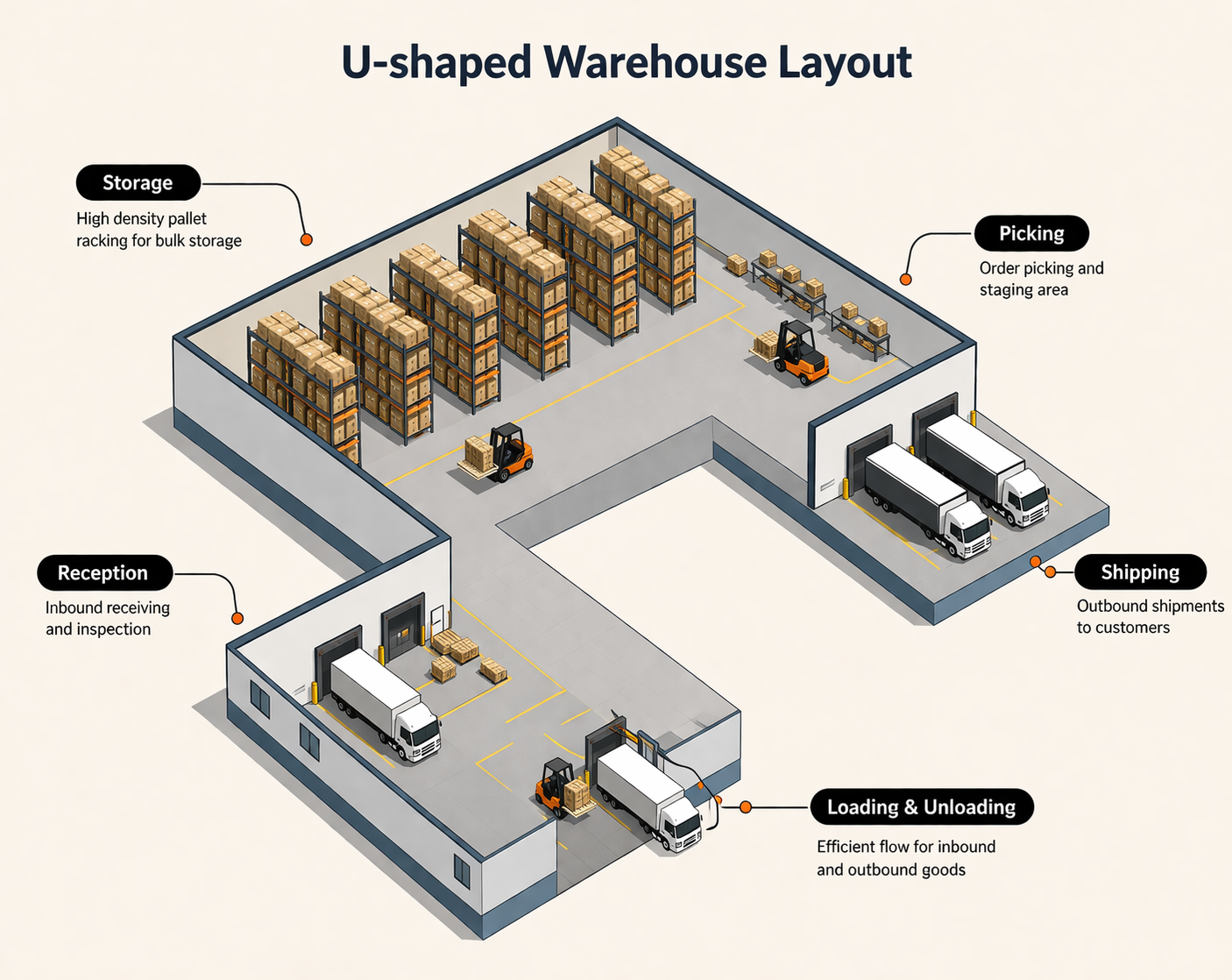
The U-flow eCom warehouse layout keeps everything connected, from receiving to shipping, in one continuous loop. It’s ideal for ecommerce warehousing with diverse SKUs and steady volume, offering flexible storage, clear picking paths, and room to scale operations or introduce automation over time.
⭐ Best For:
Medium to large ecommerce businesses, typically handling 1000-10,000+ orders per month, with broad product ranges and consistent demand.
Ecommerce Warehouse vs Ecommerce Fulfillment Center
An ecommerce warehouse focuses on storing and organizing inventory for online sales. It’s built for control, managing stock levels, space, and movement within your ecommerce logistics setup. If your priority is holding inventory efficiently and keeping products ready, a warehouse for ecommerce gives you that foundation.
An e-commerce fulfillment warehouse goes a step further. It handles the full order cycle, including picking, packing, shipping, kitting, and returns management (also known as value-added services), and connects directly to your sales channels, helping you move faster, reduce manual work, and deliver a consistent customer experience.
Ecommerce Warehouse vs Ecommerce Fulfillment Center In Comparison
| Aspect | Ecommerce Warehouse | Ecommerce Fulfillment Center |
|---|---|---|
| Primary Role | Inventory storage & organization | End-to-end order fulfillment |
| Focus | Stock control | Order speed & accuracy |
| Operations | Receiving, storage, inventory management | Picking, packing, shipping, returns |
| System Connection | Limited to inventory tracking (most of the time) | Fully integrated with ecommerce platforms |
| Best For | Holding inventory long-term | Scaling ecommerce distribution and delivery |
Beyond Storage: The Real Value Of A Fulfillment Partner
A fulfillment partner brings structure, visibility, and control to your ecommerce logistics. Inside an e-commerce fulfillment warehouse, your inventory and order fulfillment stay aligned, so you can grow without operational bottlenecks or constant firefighting.
With a fulfillment partnership, you:
Have more time to focus on growth. Spend less time on ops, more on sales and marketing.
You address fewer costly errors, thanks to improved accuracy across inventory, picking, and shipping.
Offer faster delivery, better routing, and smoother carrier coordination.
Are able to scale operations as you wish, handling spikes without hiring, training, or reorganizing.
Can be confident about deliveries and customer experience. Consistent, reliable order fulfillment builds trust.
Get clear operational visibility with real-time data to make smarter business decisions.
3PL vs Self-Storage vs Hybrid Storage Models
👉🏻 Self-storage (your home, garage, or a small unit) works when you’re starting out and keeping costs low, but it quickly becomes limiting as orders grow.
👉🏻 A 3PL or ecommerce warehouse brings structure, systems, and scale to your ecommerce logistics, taking operations off your plate.
👉🏻 Hybrid models sit in between, combining control with support. They are ideal when you’re transitioning from an early-stage to a more established ecommerce warehousing setup.
3PL vs Self-Storage vs Hybrid Storage Direct Comparison
| Storage Model | Best Stage | Pros | Limitations |
|---|---|---|---|
| Self-Storage (Home/Unit) | Early-stage (low volume) | Low cost, full control | Limited space, time-consuming, hard to scale |
| 3PL Warehousing | Scaling & established brands | Scalable, efficient, tech-enabled | Less direct control, added cost |
| Hybrid Model | Transition stage | Flexible, balanced control & support | More complex to manage |
How To Choose The Right Warehouse Location
The right ecommerce warehouse location balances speed and cost. Closer to customers means lower shipping zones and faster delivery, while proximity to ports speeds up inbound flow. Labor and real estate costs vary by region, so your setup needs to match your margins.
Some brands benefit from a single-node setup, others from a multi-node ecommerce distribution center. With jam-n nodes in Southern California (Los Angeles) and San Francisco, you stay close to ports, customers, and key demand zones, without overcomplicating your operation.
eCom Warehousing In California By jam-n
Working with the right ecommerce warehouse partner brings structure, speed, and peace of mind to your operation. You stay organized, reduce errors, and free up time to focus on growth, while your ecommerce logistics run consistently in the background.
Why brands choose jam-n:
Real-time inventory visibility across all your sales channels
Accurate pick and pack workflows that reduce costly errors
Faster shipping through optimized warehouse locations and carrier networks
Scalable ecommerce warehousing built for growth and demand spikes
Dedicated support that feels like an extension of your team
Your shipments matter to us!
Grow operations with confidence and keep every order on track.
FAQs
What Is An Ecommerce Warehouse?
An ecommerce warehouse is where your inventory is stored, managed, and prepared for shipping. It supports ecommerce logistics by keeping stock organized, accurate, and ready to move through your ecommerce warehouse process.
What Are The 4 Types Of Ecommerce?
The four main types are:
B2C (Business-to-Consumer): Businesses sell directly to individual customers (e.g., online stores).
B2B (Business-to-Business): Businesses sell to other businesses (e.g., wholesale or bulk orders).
C2C (Consumer-to-Consumer): Individuals sell to other individuals (e.g., marketplaces like eBay).
C2B (Consumer-to-Business): Individuals offer products or services to businesses (e.g., freelancers or influencers).
How Do I Get My Ecommerce Warehouse Up And Running?
Start with space, systems, and process design. Set up your ecommerce warehouse layout, implement e-commerce warehouse management software, organize inventory, and define workflows so your ecommerce logistics run smoothly from day one.
Which Ecommerce Warehousing Model Fits My Business Right Now?
It depends on your stage. Early brands may use self-storage, while growing ones shift to a 3PL ecommerce warehouse. The right ecommerce warehousing model supports your volume, complexity, and ecommerce logistics needs without slowing growth.
When Is The Right Time To Move Into An Ecommerce Warehouse?
When orders increase, space runs out, and operations take too much of your time, that’s the moment you should switch to a 3PL with a professional establishment.
What Are The Four Types Of Warehousing?
The main types include private, public, bonded, and smart warehouses. Each supports ecommerce warehousing differently, depending on control, cost, and technology needs within your ecommerce logistics and ecommerce warehouse management strategy.
What Are The 5 C's Of Ecommerce?
The 5 C’s are Content, Commerce, Community, Connection, and Customization. Together, they shape customer experience and inspire brand loyalty.
Follow: @jamnlogistics