
How Fulfillment Outsourcing Works: A Guide For Online Brands
You started your brand to sell great products, not to spend Saturday nights printing shipping labels in your garage. So, let’s talk a bit about outsourced fulfillment. Handing your warehousing, picking, packing, and shipping to a specialized partner gives you back your time and space, while your customers still get the fast, accurate deliveries they expect.
In this guide, we'll cover how it works, what it costs, and when it's the right move.
TL;DR
Outsourced fulfillment means hiring a 3PL to handle storage, picking, packing, shipping, and returns.
Send inventory to the 3PL, sync your sales channels, and orders will ship automatically.
The biggest wins: lower costs, faster shipping, broader geographic reach, and more time to focus on growth.
It's the right move when order volume is eating your time, you're running out of storage, or you want to ship faster nationwide.
The right 3PL combines technology, accuracy, transparency, and a true partner mindset.
What Is Outsourced Fulfillment?
Outsourced fulfillment is the practice of partnering with a third-party logistics company to manage your order fulfillment from end to end. Instead of storing inventory at home, in your garage, or in a leased warehouse, you send products to a 3PL's facility. They handle the rest: receiving, storing, picking, packing, shipping, and returns.
It's a form of supply chain outsourcing that lets brands tap into infrastructure, technology, and shipping rates that would otherwise be out of reach. According to the Association for Supply Chain Management, 3PLs help companies scale operations without scaling overhead.
New to the model? Our 3PL guide breaks it down further.
How Outsourced Order Fulfillment Works
Here's the typical flow once you partner with a 3PL.
1. Receiving & Storage
You ship products to your 3PL's warehouse. The team checks the shipment, scans each SKU, and stores items in dedicated bins, shelves, or pallet locations. Smart slotting puts fast-moving SKUs near the packing area for quicker, more accurate picks.
2. Channel Integration
Your 3PL's WMS connects to Shopify, TikTok Shop, Amazon, Walmart, BigCommerce, or your EDI feed. Orders flow in automatically, and inventory updates in real time across every channel.
3. Picking & Packing
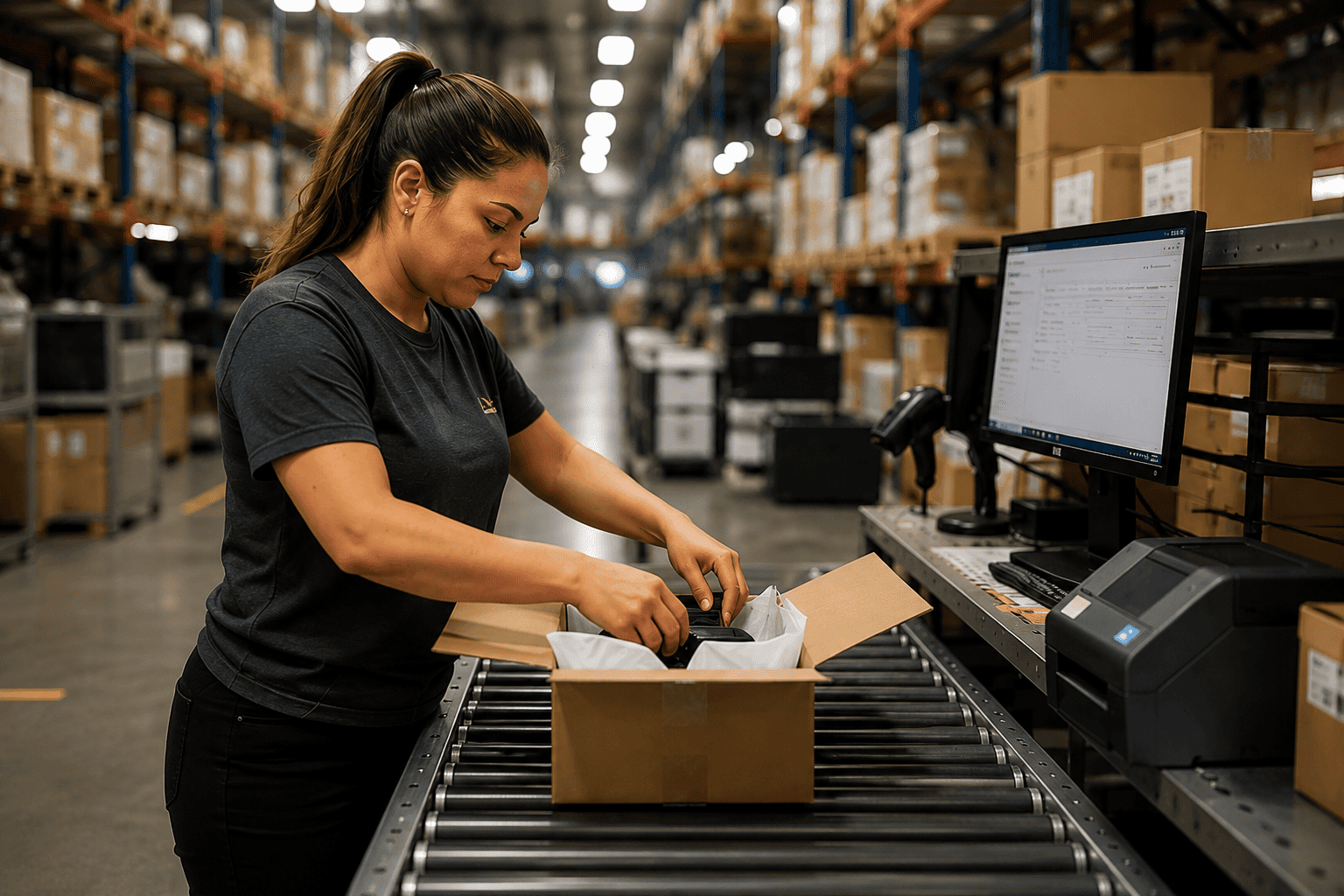
When an order comes in, the system generates a pick list. A warehouse associate grabs the items and packs them in the right-sized box or mailer. We make sure barcodes get scanned at every step. And that means 99.99% accuracy across 2.4 million orders.
4. Shipping
Your 3PL applies the label using the most cost-effective carrier for the destination. Carriers pick up daily, and tracking updates are sent to your store and your customer's inbox.
5. Returns Processing
When something comes back, your 3PL inspects, restocks, refurbishes, or disposes of it according to your rules, then inventory updates automatically.
In-House vs Outsourced Warehousing And Fulfillment
Should you keep things in-house or hand them off? Here is a comparison table.
| Factor | In-House | Outsourced |
|---|---|---|
| Upfront Cost | High (lease, equipment, hires) | Low (pay-as-you-grow) |
| Scalability | Limited by space and staff | Scales with order volume |
| Shipping Speed | One location only | Multi-node = faster delivery |
| Technology | You build or buy your WMS | Included with the 3PL |
| Best For | Tiny volumes or made-to-order items | Brands shipping 100+ orders/month |
For most growing brands, outsourced warehousing wins on cost, speed, and peace of mind. In-house only makes sense for very low-volume, custom products or special handling needs. For more, see our ecommerce warehousing guide.
What Are The Three Types Of Fulfillment Centers?
When researching outsourced ecommerce fulfillment, you'll come across three main facility models.
| Type | Best For | Trade-Offs |
|---|---|---|
| Multi-Client Warehouse | Most online brands; cost-efficient with shared resources | Less customization than dedicated space |
| Dedicated Fulfillment Center | High-volume brands with custom workflows | Higher fixed cost, longer commitment |
| On-Demand / Flex Warehouse | Seasonal overflow or short-term storage | Less consistent service, limited tech |
Most growing brands start in a multi-client setup, which is flexible, affordable, and easy to scale up or down. As volume grows, some move towards a dedicated space within a 3PL network.
What Are The Four Types Of Outsourcing?
When people ask about outsourcing in supply chain management, they usually mean four levels of provider relationships.
First-party logistics (1PL): You handle everything yourself, from manufacturing to delivery.
Second-party logistics (2PL): You hire a carrier (FedEx, UPS) to move freight, but manage the rest in-house.
Third-party logistics (3PL): A partner like jam-n handles warehousing, fulfillment, and shipping for you.
Fourth-party logistics (4PL): A strategic partner manages your entire supply chain, including the 3PLs you are working with.
For most online brands, outsourcing in the supply chain starts at the 3PL level, meaning operational support without giving up strategic control. For a deeper comparison, see our 3PL vs 4PL breakdown.
When Is It Time To Outsource?
Not sure if you're ready for logistics management outsourcing? Here are the most common signs your business would benefit from outsourcing supply chain operations:
You spend 10+ hours a week on packing and shipping.
Storage is overflowing into hallways or rented mini-storage units.
Order volume is growing faster than you can fulfill accurately.
Customers complain about delivery speed or shipping costs.
You're expanding into wholesale, retail, or new marketplaces.
Peak season feels like a four-month emergency every year.
EDI compliance is causing chargebacks you can't manage in-house.
If two or more sound familiar, it's probably time to talk to a 3PL.
How To Choose An Outsourced Ecommerce Partner
Picking a 3PL is a big decision. Your customers' experience depends on it. And when the supply chain is managed according to a plan that works, companies tend to grow faster. Here's what to look for:
Technology & Integrations: native connections to every channel, with real-time visibility.
Accuracy & SLAs: ask for accuracy rates, on-time rates, and how they're measured.
Network & Coverage: a multi-node U.S. network (facilities in LA and California) usually pays for itself in shipping savings.
Transparency: clear pricing, no hidden surprises, 24/7 access to inventory and orders.
Partnership Mindset: your 3PL should feel like an extension of your team: proactive and invested in your growth.
Common Services And Pricing
Most 3PLs bundle a core set of services, like receiving, storage, pick and pack, kitting and assembly, returns management, and omnichannel fulfillment. Pricing scales with your business, so you don't pay for empty space in slow seasons.
| Fee | What It Covers |
|---|---|
| Receiving | Unloading and checking in inbound inventory |
| Storage | Monthly fee per pallet, shelf, or bin |
| Pick & Pack | Per-order or per-item charge |
| Shipping | Carrier rate, often passed through with volume discounts |
| Value-Added | Kitting, gift notes, branded packaging |
| Returns | Per-return fee for inspection and restocking |
According to the U.S. Census Bureau, online sales continue to grow as a share of total retail, and brands with flexible fulfillment infrastructure are best positioned to ride that growth.
Ready To Outsource? Let's Talk!
Whether you're shipping 100 orders a month or 100,000, jam-n is built to grow with you. We combine 30+ years of expertise, a multi-node U.S. and Canada network, best-in-class technology, and a partnership mindset that treats your success as our own.
Let's map your fulfillment plan together!
Frequently Asked Questions
What Is Outsourced Fulfillment?
Outsourced fulfillment is when a brand partners with a third-party logistics provider to handle warehousing, picking, packing, shipping, and returns. You send inventory to the 3PL, and they fulfill orders on your behalf.
What Are The Main Types Of Fulfillment Centers?
The three main types are multi-client warehouses (shared by many brands), dedicated fulfillment centers (private space and staff for one brand), and on-demand or flex warehouses (short-term overflow space). Most growing brands start with multi-client setups.
What Are The Four Types Of Outsourcing?
The four levels of supply chain outsourcing are 1PL (you do it all), 2PL (you hire a carrier), 3PL (a partner handles warehousing and fulfillment), and 4PL (a partner manages your whole supply chain). Most brands work with 3PLs.
Is Outsourced Ecommerce Fulfillment Cheaper Than In-House?
For most growing brands, yes. Outsourcing replaces fixed costs like leases, equipment, and staff with variable costs that scale with order volume. You also gain discounted carrier rates and built-in technology.
What Is The Average Onboarding Time For A 3PL Partner?
Most brands onboard in two to six weeks. The process includes connecting your sales channels, validating SKU data, sending inventory, running test orders, and going live. Larger brands may take longer with EDI or retail compliance.
Can Outsourced Order Fulfillment Handle Wholesale And B2B Orders?
Absolutely. The right 3PL supports DTC and wholesale workflows, including EDI integrations, retail routing guide compliance, carton labeling, and ASN generation. This keeps B2B orders accurate and chargeback-free.
Follow: @jamnlogistics