
What Is Reverse Logistics? Examples, Benefits & How To Optimize
Returns happen. Whether you sell to retailers or ship 10,000 ecommerce orders a day, the way you handle what comes back shapes your margins, your customer relationships, and your inventory recovery. This guide breaks down what reverse logistics is, the main types, real examples, and how to make the return process better for your business.
TL;DR
Reverse logistics moves products backward through the supply chain, from end customer to retailer, manufacturer, or recycler.
It covers returns, refurbishment, recycling, packaging reuse, unsold inventory, end-of-life handling, and warranty repairs.
A smooth return experience drives repeat purchases, especially for e-commerce brands where return-friendly policies directly affect customer loyalty.
Optimizing reverse logistics saves money, reduces waste, and surfaces product data you can use to improve forward logistics.
The right 3PL partner keeps returns, repackaging, and resale moving, so value flows back into inventory instead of getting stuck.
What Is Reverse Logistics? (Definition)
Reverse logistics is the flow of products and materials back through your supply chain after delivery. It includes customer returns, repairs, refurbishment, recycling, disposal, packaging reuse, and unsold inventory management. For consumer goods brands, a strong reverse logistics process helps recover product value, reduce waste, control costs, and create a better post-purchase experience. Instead of treating returns as a supply chain headache, you can turn them into a smarter way to protect margins and keep customers coming back.
3 Reverse Logistics Examples
Reverse logistics examples across different sectors show how a returns flow can be turned into real business value:
Consumer electronics refurbishment: A headphone brand sees a steady volume of warranty returns and trade-ins. Each unit is inspected, cleaned, and refurbished where possible. Working units are resold through a "certified renewed" channel at a lower price, while damaged ones are harvested for repair stock. The brand keeps inventory liquid and cuts e-waste at the same time.
Apparel and footwear circularity: A direct-to-consumer apparel brand offers a "return and recycle" program. Customers ship back worn shoes in any condition. Wearable pairs go to a recommerce site; worn-out pairs go to a partner that grinds them into raw material for new product runs. Result: lower acquisition cost on the recommerce channel and a sustainability story that actually holds up.
Subscription beauty refills: A beauty subscription brand built a refill program where customers return empty containers in prepaid mailers. Containers are cleaned, refilled, and shipped back out, cutting packaging spend, reducing single-use plastics, and giving customers a reason to stay subscribed.
The Difference Between Forward And Reverse Logistics
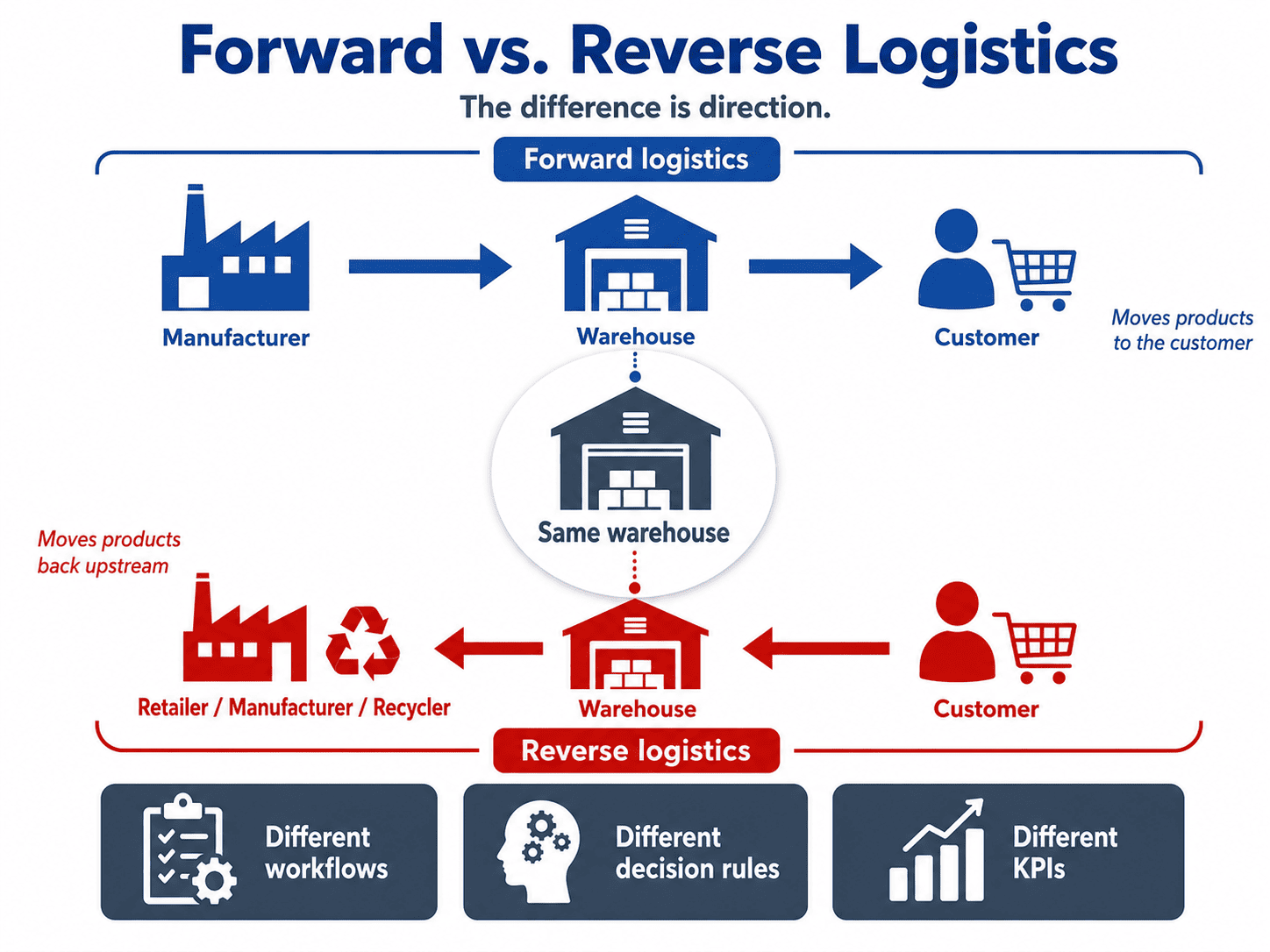
The difference between forward and reverse logistics is direction. Forward logistics moves a product from the manufacturer toward the end customer. Reverse logistics moves it the other way, from the customer back to a retailer, manufacturer, or recycler. The same warehouse can handle both, but they call for different workflows, different decision rules, and different KPIs.
9 Types Of Reverse Logistics Flows
There isn't a single return flow. Several types of reverse logistics workflows can be implemented, and most operations use a mix of them to manage different types of returns.
1. Returns Logistics Management
This is the most visible flow. Returns management handles regular customer returns and works to prevent unnecessary ones through better product descriptions, accurate fulfillment, and clear policies. Customers judge a brand on how easy this process is.
2. Return Policy And Procedure
Your return policy is the rulebook every return is measured against. It should be visible, consistent, and applied the same way every time. In retail, a strong reverse logistics process starts with consistent return policies that protect margins while keeping shoppers confident.
3. Remanufacturing Or Refurbishment
In this case, a brand decides to recondition returned items rather than scrapping them. This recovers value, reduces waste, and often opens a secondary sales channel through "renewed" or "open-box" inventory.
4. Packaging Management
Packaging management refers to reusing cartons, dunnage, pallets, and totes wherever possible. This is one of the easiest wins in reverse logistics operations, because it cuts material spend and disposal volume in one move.
5. Unsold Products
Unsold products return from retailers back to manufacturers, and are usually triggered by poor sell-through, obsolete inventory, or delivery refusal. These flows matter in reverse logistics fulfillment for brands selling into big-box retail.
6. End Of Service Life
When a product reaches the end of its useful life, it needs to be recycled or disposed of properly. Manufacturers in regulated categories often have legal obligations here.
7. Delivery Failure
Failed deliveries get returned to a sorting center and then back to their origin. Efficient operations try to correct the issue and resend before the package starts its journey back.
8. Rental Equipment
Leased or rented equipment returns at the end of its contract for redeployment, recycling, or resale.
9. Repair & Maintenance
Warranty repairs and serviceable returns help customers get a working product back rather than a refund. This is a common practice in consumer electronics and durable goods.
The Reverse Logistics Process In 5 Steps
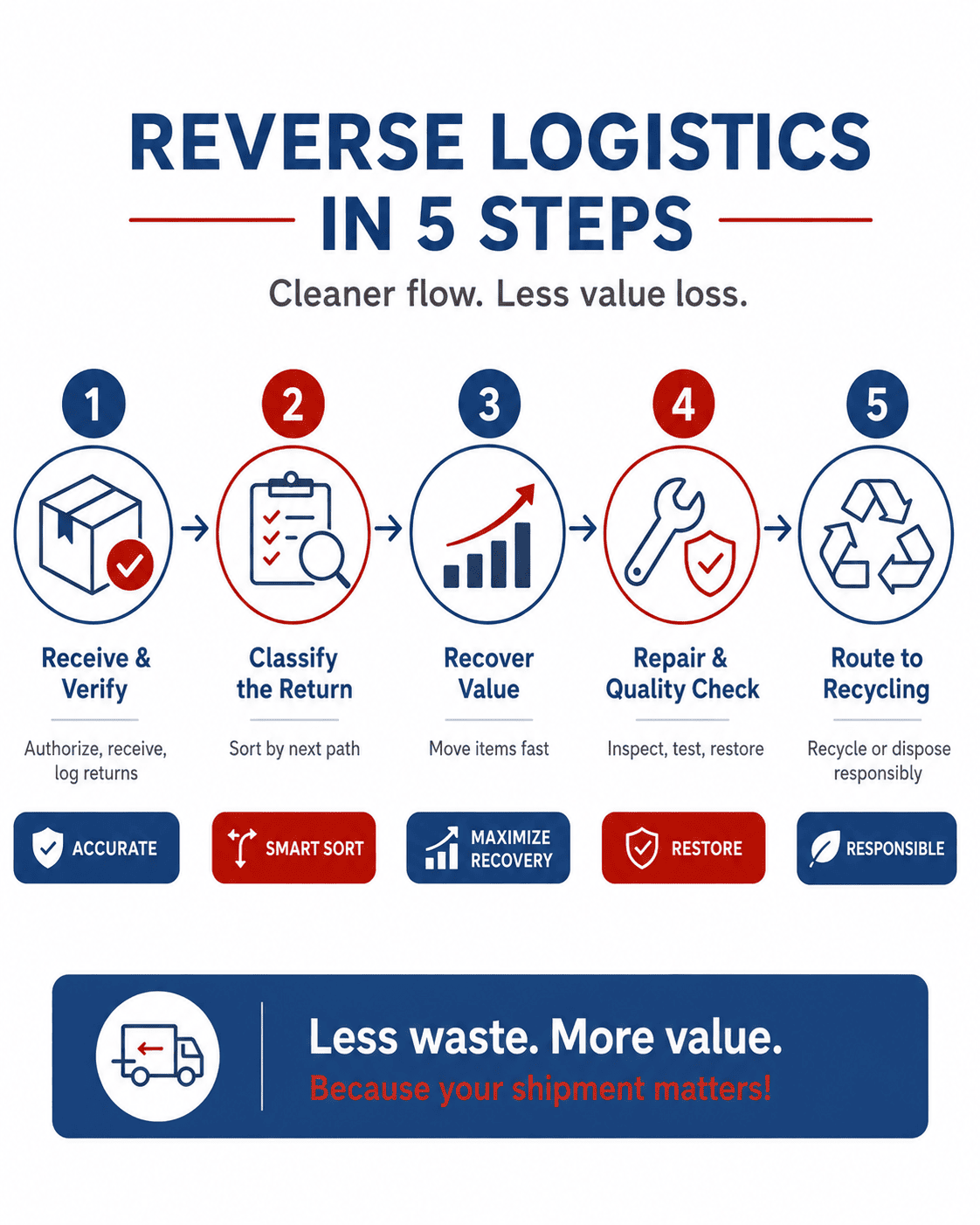
Most reverse logistics processes follow the same five-stage flow. The cleaner each stage, the less value leaks out.
1. Receive & Verify The Return
The reverse logistics process starts the moment a customer initiates a return. You need a standard operating procedure on:
How the return is authorized,
How it gets back to you,
What happens when it arrives.
Without this step nailed down, trucks roll inefficiently, and items pile up in receiving.
2. Classify The Return
Inspect each returned item and sort it into one of the following categories:
Resaleable,
Refurbishable,
Recyclable,
Disposable.
If you sell through marketplaces like Amazon, your customers may need to provide a return reason up front, so the sortation decision is partly made before the box even arrives.
3. Recover Value
Keep returns in motion. Returned items lose value the longer they sit, whether through depreciation, damage, missing packaging, or seasonal demand changes. Reverse logistics management moves each item quickly to the right next step (restock, repair, repackage, resell, recycle, or dispose) so you recover as much value as possible before the product becomes dead inventory.
4. Handle Repairs & Quality Checks
Send repairable items to the repair workflow. Repair, restock, or part out. Don't let inventory get stuck in limbo. Parts that can't be saved as full units can often be harvested for warranty stock.
5. Route Unsellable Items To Recycling
If it can't be sold or repaired, dispose of it responsibly. This step is the end of the reverse logistics workflow, but it helps you build a sustainability case your brand can stand behind.
How Does Reverse Logistics Impact Your Business?
Reverse logistics flows affect margin, customer retention, and brand perception all at once. Fast, accurate returns build repeat purchases. Slow, sloppy ones drive customers away and tie up working capital in unsellable inventory.
How To Evaluate The Process Of Your Reverse Logistics Workflow
Track KPIs tied to the five "R's": returns, repackaging, repairs, recycling, replacements.
Return rate: number of returned orders as a percentage of all orders. If high, watch for product quality signals.
Resale rate: percentage of returns that get repackaged and resold.
Repair cost per unit: keeps refurbishment from becoming a money pit.
Recycling rate: percentage of materials diverted from landfill.
Replacement rate: flags product defects, sizing, or use instruction problems.
How To Optimize Reverse Logistics Processes
The following reverse logistics best practices cover where most brands find the biggest wins.
Best Practices For Reverse Logistics In The Retail Industry
| Best Practice | Why It Matters |
|---|---|
| Review your return and repair policies | Clear policies prevent downstream confusion, delays, and unnecessary handling costs. |
| Use returns data to recognize patterns | Returns data helps you spot recurring issues like sizing confusion, damaged packaging, etc., so you can fix the root cause instead of processing the same problem again and again. |
| Track products both ways | When you know where products went and how they came back, you can act faster and smarter. If a recall happens, you can identify the affected batch or SKU instead of removing more inventory than necessary. |
| Centralize your returns area | A dedicated returns zone or warehouse area helps teams sort, inspect, and make faster decisions. |
| Integrate forward and reverse routes | Drivers can pick up returns during outbound runs, helping reduce extra trips and transportation costs. |
| Automate with a WMS | A WMS helps track recovery, manage refurbishment queues, and surface analytics for smarter decisions. |
Benefits Of Reverse Logistics
The benefits of reverse logistics span across financial, operational, and reputational dimensions. When the process is set up well, the benefits of reverse logistics management include:
Lower costs through packaging reuse and recovered inventory value.
Better customer satisfaction and retention thanks to easy, predictable returns.
Faster service for replacements and warranty repairs.
Loss reduction by recapturing value from items that would otherwise be written off.
Improved brand sentiment, since the return experience is now part of the brand experience.
Less waste and stronger ESG metrics through recycling and reuse.
Better forward and reverse supply chain management and visibility, since returns data feeds back into forecasting and product development.
👉🏻 This is where the importance of reverse logistics in supply chain management gets clear: returned goods are part of reverse logistics, and when handled well, they protect margin and build trust at the same time.
Simplify Your Reverse Logistics Supply Chain With A Hands-On 3PL Partner
At jam-n, we focus on what we do best: high-volume consumer goods fulfillment across ecommerce, B2B, retail, wholesale, and omnichannel. That includes handling the returns flow that comes with it.
Don’t let value slip through the cracks. With three Los Angeles warehouses and 30+ years of experience, we can keep your shipments moving, both directions.
FAQs
How Does Reverse Logistics Work?
Reverse logistics works by moving a product backward through the supply chain after it leaves the end customer. The item is authorized for return, transported to a returns center, inspected, and then routed to resale, refurbishment, recycling, or disposal, whichever option recaptures the most value for the brand.
How Can Brands Handle Returns Without Letting Costs Climb?
The fastest wins come from centralized returns handling and a WMS that tracks every unit through the process. Pair that with steady analysis of return reasons, and you can fix 99% of the root causes that drive returns in the first place.
What Is Reverse Distribution?
Reverse distribution is another term for reverse logistics; the flow of goods from the point of sale back to the manufacturer or distributor for recovery, repair, recycling, or disposal. Some teams use "reverse distribution" specifically for the physical transport side, with "reverse logistics" covering the full end-to-end process.
Follow: @jamnlogistics