
What Is Minimum Order Quantity (MOQ)? Formula, Pros & Cons
Throughout your brand’s history, we’re pretty sure you’ve had to face the following hurdle more than once: the perfect supplier is under your radar. The per-unit price looks great, the samples are spot on, and then you spot the caveat; they will only sell you 5,000 units at a time. That number is the minimum order quantity, and it can quietly make or break your cash flow, your storage plan, and your margins.
In business, the knowledge to make informed decisions is power. Before you commit to anything, let's uncover what minimum order quantity really means, its advantages and pitfalls, how it is calculated, and how you could make it work for you instead of against you.
TL;DR
MOQ (minimum order quantity) is the smallest amount, in units or dollars, that a supplier or manufacturer will sell you in a single order.
Suppliers set MOQs to spread their fixed setup costs across enough units to stay profitable on every production run.
There is no single MOQ formula, but it always comes down to three things: demand, holding cost, and the break-even point where an order finally pays off.
Pros: a lower cost per unit and steadier supply. Cons: more cash committed up front and more warehouse space tied up.
The right 3PL partner turns a big MOQ into organized, shippable inventory, so the volume you commit to keeps moving instead of gathering dust.
MOQ Meaning: What Is It, Exactly?
To start getting things into perspective, MOQ stands for minimum order quantity, i.e., the lowest amount (in units or dollars) a supplier or manufacturer will agree to sell in one go. If a factory sets an MOQ of 1,000 units, you cannot order 400. You either order 1,000, or you go find another supplier.
Generally, it shows up in one of two ways:
Simple MOQ: one clear minimum, like 500 units or $2,000 per order.
Complex MOQ: more than one rule at once, such as a minimum number of units per SKU plus a minimum total order value.
You will bump into MOQs most often when you buy from factories, wholesalers, and overseas manufacturers. And the number ripples through everything downstream, from how much you spend up front to how much space you need to store it all. Which is exactly why keeping your inventory accurate and shippable matters from the moment goods hit the dock.
Why Suppliers Set A Minimum Order Quantity
Do not trick yourself into believing that an MOQ is a supplier being difficult. It is simple math on their end.
Every production run comes with fixed costs baked in. Think machine setup, labor, sourcing materials, and the admin that ties it all together. To turn a profit, a supplier has to spread those costs across enough units. Sell too few, and the run loses money, so they set a floor. Bigger orders also mean fewer transactions to juggle and better economies of scale, which is why they usually come with a friendlier price per unit.
For you, the buyer, all of that lands squarely in your cash flow. And cash flow is no small thing. In the Federal Reserve's Small Business Credit Survey, about half of small firms flagged uneven cash flow as an ongoing challenge. Commit to a big order months before you sell it, and that squeeze only gets tighter, so it pays to plan before you pull the trigger.
MOQ In Manufacturing And Wholesale
Not all minimums are created equal. MOQ manufacturing minimums and wholesale minimums play by very different rules, so knowing which one you are dealing with helps you plan better.
Manufacturing MOQ: usually higher. Factories deal with tooling, molds, and setup time, so they need volume to justify a run. Custom or private-label products often carry the steepest minimums of all.
Wholesale MOQ: usually lower. Wholesalers and distributors sell existing stock, often by the case or pallet, so their minimums tend to be friendlier for smaller brands.
So if you are an importer moving goods through the Ports of Los Angeles and Long Beach, chances are you are staring down manufacturer-level MOQs by the container. That kind of volume needs a home the moment it lands, which is where solid B2B fulfillment and wholesale logistics come in handy.
MOQ Meaning In Shipping And Fulfillment
Here is the part a lot of brands miss: MOQ in shipping goes well beyond the purchase order.
A high MOQ means a mountain of inventory arriving all at once, often as container loads, pallets, or cartons. Every bit of it has to be received accurately, stored efficiently, and then broken down into sellable units for your retail and ecommerce orders. Get that handoff wrong, and your great per-unit price quietly evaporates into storage headaches and picking errors.
This is exactly the kind of process a trusted 3PL partner like jam-n is built for. We turn your containers into organized, retail-ready inventory, and then handle retail distribution to keep every PO compliant and on time. Rest easy knowing the volume you committed to actually moves.
The MOQ Formula: Tips On How To Calculate It
This is the point where numbers get into the game. There is no single universal MOQ formula, but there is a clear way to think about it from both sides of the table.
A supplier setting an MOQ weighs three things:
Demand: how many units realistically sell in a set period.
Holding cost: what it costs to store a unit over that period.
Break-even: the point where the order covers fixed costs and finally earns a margin.
On your side of the table, a handy companion is the Economic Order Quantity (EOQ), which estimates your ideal order size:
EOQ = the square root of (2 x annual demand x ordering cost per order) divided by holding cost per unit per year
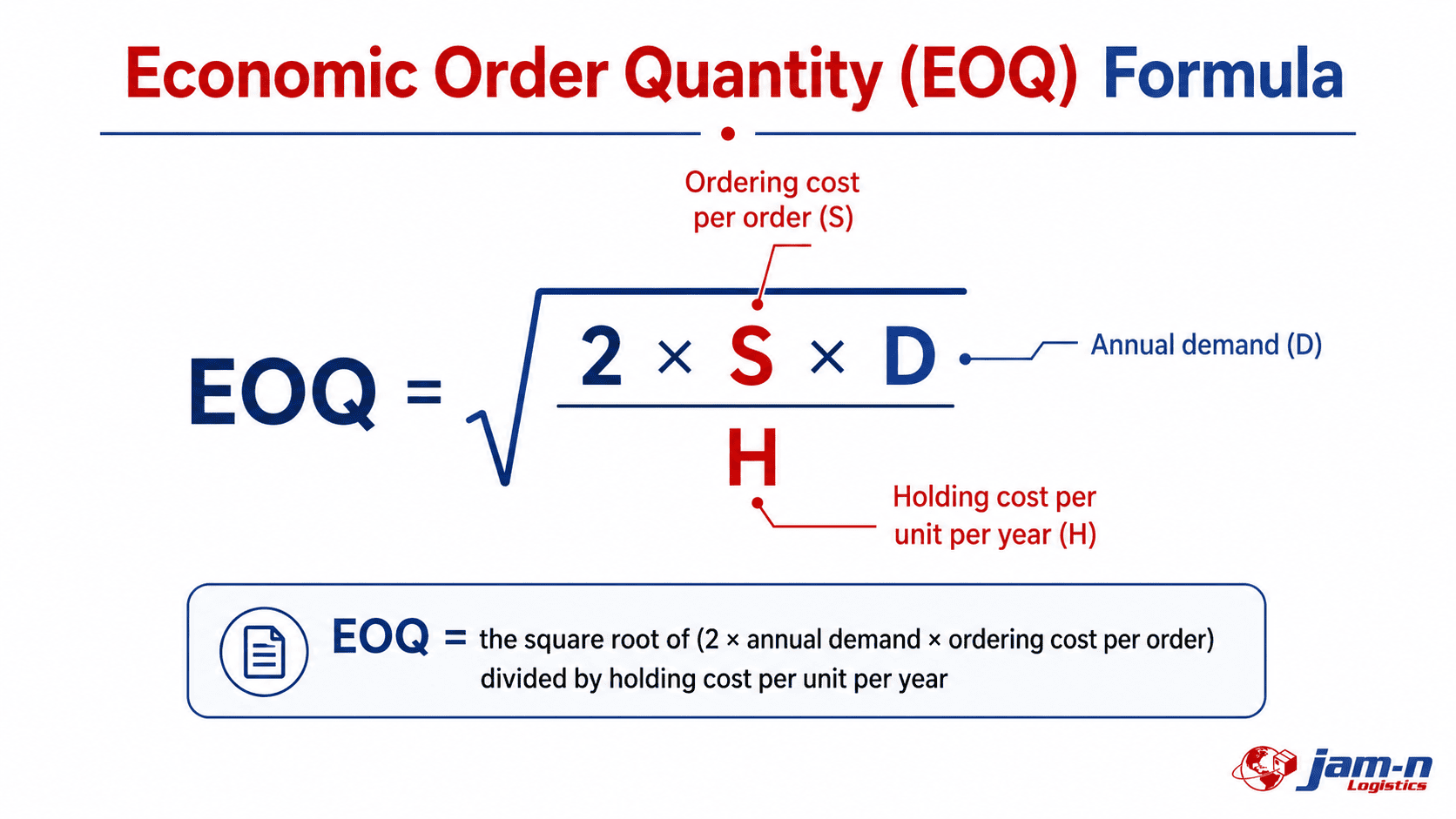
If a supplier's MOQ sits close to your EOQ, the deal makes sense. If it towers above your EOQ, you are probably buying more than you can move without tripping over it. As inventory is far from free to hold, most companies try to keep holding costs in the range of 20% to 30% of inventory value a year, according to the Institute for Supply Management. So every extra unit you order is not just cash parked on a shelf; it is cash quietly leaking off it.
A Minimum Order Quantity Example
Numbers on paper are one thing. A quick minimum order quantity example makes it real.
Say your supplier sets an MOQ of 1,000 units per SKU at $3 a unit. That is $3,000 committed up front for a single product. Now, if you sell around 200 units a month, that one order is roughly five months of stock parked in your warehouse.
Here is the trade-off at a glance:
| What You Gain | What It Costs You |
|---|---|
| Lower price per unit at 1,000 units | $3,000 tied up before you sell a thing |
| One order instead of five | Five months of storage per SKU |
| Priority with your supplier | Risk of overstock if demand dips |
The math only works if you can store that inventory cleanly and move it on schedule. A hypothetical 500-unit MOQ might cost a little more per unit, but it keeps your cash, and your shelves, a whole lot freer.
The Pros & Cons Of MOQ
Every MOQ is a balancing act, so here is the honest picture.
| Pros Of MOQ | Cons Of MOQ |
|---|---|
| Lower cost per unit | More cash committed up front |
| Better supplier relationships and priority | Higher storage and holding costs |
| Fewer, more predictable reorders | Risk of overstock and dead stock |
| Easier production planning | Cash-flow pressure for smaller brands |
| Volume that suits retail and wholesale channels | Slower to test new products |
None of those cons are dealbreakers though, if you have the right setup. Solid forecasting, smart storage, and a fulfillment partner who keeps inventory moving can turn a scary MOQ into a very manageable one.
How To Manage MOQ Without Drowning In Inventory
A few practical moves keep MOQs firmly on your side.
Negotiate
Suppliers often flex on MOQ for repeat orders, longer contracts, or bundled SKUs. It never hurts to ask.
Start With Wholesale
Test a product through a lower-MOQ wholesaler before committing to a full factory run.
Forecast First
Order against real sales data, not a gut feeling.
Stagger Deliveries
Some suppliers will hold stock and ship in waves, easing the storage hit.
Watch Your Stock In Real Time
Reorder on data, so you sidestep both stockouts and overstock.
How jam-n Turns A Big MOQ Into Shippable Inventory
And here is where we come in. When your MOQ shows up as containers and pallets, we help you turn it into organized, sellable stock without the chaos.
From our three Los Angeles-area warehouses, all minutes from the Ports of LA and Long Beach, we receive your freight accurately, store it across the space you actually need, then pick, pack, and ship it to both retail and DTC channels. In 2025, we shipped 2.4 million orders at 99.99% accuracy. Not to toot our own horn, but the numbers speak for themselves.
Better still, we work like an extension of your team, so the volume you committed to keeps moving with dependable pick and pack and clear, real-time visibility. When you succeed, we succeed.
Let's Work Together
Bringing high-MOQ freight into Los Angeles? We will help you store it, organize it, and keep it moving to your customers and your retailers. Contact us today, because your shipment matters!
FAQs
What Does MOQ Mean?
MOQ means minimum order quantity, the smallest amount (in units or dollars) a supplier or manufacturer will sell in a single order.
What Is A Good MOQ For A Small Business?
It depends on your demand, your margins, and your storage. Lower minimums are the safer bet when you are testing a new product, since they keep less cash tied up. As sales become predictable, higher MOQs and their lower per-unit prices start to pay off.
How Do I Calculate MOQ?
Suppliers base MOQ on demand, holding cost, and break-even. As a buyer, compare a supplier's MOQ to your Economic Order Quantity (EOQ) to see whether the minimum actually matches how much you can move.
Can You Negotiate MOQ With A Supplier?
Often, yes. Repeat orders, longer contracts, bundling multiple SKUs, or committing to a forecast can all bring an MOQ down. So ask before you assume the number is set in stone.
How Does MOQ Affect Shipping And Fulfillment?
A bigger MOQ means more inventory arriving at once, and all of it has to be received, stored, and picked correctly. A reliable 3PL partner keeps that volume organized and shippable, so your per-unit savings do not vanish into storage and errors.
Follow: @jamnlogistics