
What Is Fulfillment By Merchant? How Amazon’s FBM Works
Not every product needs to live in an Amazon warehouse. With Fulfillment By Merchant (FBM), you sell on Amazon while your inventory stays on your own shelves or with a 3PL you choose, and your team takes each order from packing to delivery.
That freedom comes with a scorecard. Amazon still sets the rules on shipping speed, tracking, and returns, so FBM pays off when you know what’s being measured and where your stock ships from. Keep reading to discover the pros and cons of fulfilling orders yourself, compared to the rest of the options.
TL;DR
Fulfillment By Merchant (FBM) means you sell on Amazon but store, pack, and ship the orders yourself or through a 3PL.
Amazon's side of FBM pricing is short: a selling plan and a referral fee. The rest of your cost depends on how well you ship.
Amazon watches three numbers closely: order defects, late shipments, and cancellations.
Your ship-from location shapes the delivery date shoppers see, so your warehouse choice affects sales.
Dropshipping counts as FBM, but only when you’re clearly the seller of record.
Amazon FBM Meaning: Fulfillment By Merchant In Simple Terms
Amazon FBM is a setup where Amazon runs the storefront and the checkout, and you handle everything that happens after the “Buy Now” click. You’ll also see it called fulfilled by merchant, or MFN, short for merchant fulfilled network. MFN is the label Amazon uses in many Seller Central reports and listing settings, so if you spot it there, it means the same thing.
A few more terms come up again and again once you start:
Handling Time: The number of business days you need to get an order out the door
Ship-by Date: Your deadline to confirm shipment with tracking
Shipping Template: Your rules for shipping rates, regions, and transit times
Buy Shipping: Amazon’s built-in tool for buying carrier labels
Account Health: The dashboard where Amazon scores your performance
If you’d rather not run a packing station yourself, a reliable ecommerce fulfillment partner like jam-n can store, pack, and ship under your seller account while you keep running the listings and pricing.
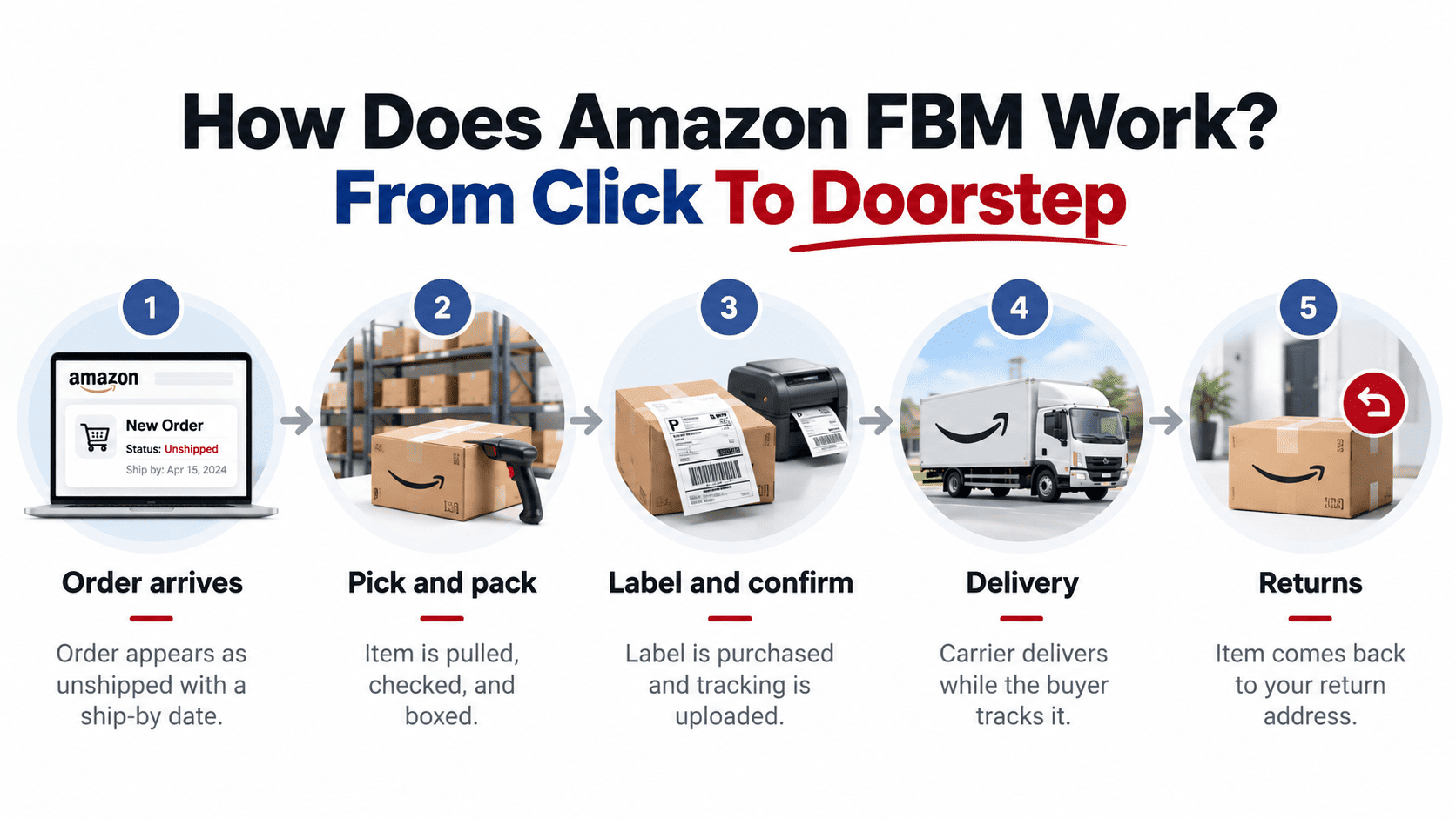
How Does Amazon FBM Work? From Click To Doorstep
Each FBM order moves through five stages, and each one has its own weak spot:
Order arrives. It shows as unshipped, with a ship-by date. Watch out for a handling time set too short.
Pick and pack. The item is pulled, checked, and boxed. Watch out for wrong items and weak packaging.
Label and confirm. A label is bought and tracking is uploaded. Watch out for confirming after the ship-by date.
Delivery. The carrier delivers while the buyer tracks it. Watch out for transit times set too tight.
Returns. The item comes back to your return address. Watch out for missing Amazon’s 24-hour response window.
The packing step deserves extra care. In ICSC's 2024 consumer returns survey, receiving damaged items (52%) or the wrong item (37%) were among the top reasons shoppers gave for sending online purchases back. Both problems start at the packing table, which is why careful pick-and-pack work, with barcode scans at every step, is worth getting right.
Amazon FBM Shipping: Labels, Speed, And The Prime Badge
Amazon says Buy Shipping rates are over 31% lower on average than retail ground rates for UPS, FedEx, and USPS. Also, labels bought there come with extra protection against A-to-Z claims when you ship on time. Plus, its Shipping Settings Automation feature sets delivery dates using your location, the buyer’s location, and past delivery data.
And Prime? Standard FBM listings don’t carry the badge. Amazon reopened Seller Fulfilled Prime enrollment in 2023 after a long pause, with tough standards for on-time and weekend delivery. It’s worth a look once your FBM numbers are steady.
Amazon FBM Requirements That Protect Your Account
Amazon grades merchant-fulfilled sellers against a short list of performance numbers, and missing them can put your selling privileges at risk:
| Metric | What It Measures | Target |
|---|---|---|
| Order Defect Rate | Negative feedback, A-to-Z claims, and chargebacks | Under 1% |
| Late Shipment Rate | Orders confirmed after the ship-by date | Under 4% |
| Cancellation Rate | Orders you cancel before shipping | Under 2.5% |
Returns come with their own rules. Amazon automatically enrolls US FBM sellers in prepaid returns, expects return requests to be handled within 24 hours, and requires sellers to accept returns within the 30-day window that applies to most products. Amazon also monitors valid tracking and on-time delivery, so every order should go out with a working tracking number.
Amazon FBM Fees And FBM Pricing: What You Really Pay
On Amazon’s side, the bill is short: a selling plan, a referral fee of 5% to 45% depending on the category (usually with a $0.30 minimum), and a $1.80 closing fee on media items only.
The Plan Math: Individual Or Professional?
The Individual plan costs $0.99 per item sold, while Professional is a flat $39.99 a month. Divide the monthly fee by the per-item fee, and the break-even lands at about 40 items. Once you sell more than that each month, Professional costs less, and it adds bulk listing and advertising tools along the way.
Your Cost Per Order
Everything after the referral fee is yours to manage, and each cost has its own lever:
Shipping Label: Package weight, size, and distance from your warehouse
Packaging: Box size and materials
Labor: Picking speed and accuracy, or your 3PL's per-order fee
Storage: How long stock sits before it sells
Returns: How often items come back, and in what shape
Because Amazon never handles the stock, FBM orders carry no FBA fulfillment, storage, aged inventory, or inbound placement fees. Add these five costs to Amazon's fees, and you have your true FBM cost per order.
When Selling Fulfilled By Merchant Makes Sense
New product you’re testing. List it, ship the first units yourself, and see how it sells before sending inventory into Amazon's network.
Slow-moving or seasonal products. Stock that sits for months for its season doesn't collect Amazon storage charges while it waits.
Personalized or made-to-order items. Anything engraved, printed, or assembled after the order comes in needs hands-on work before it ships.
Choosing An FBM Warehouse: Location Changes The Promise
Amazon builds each delivery date from your handling time, your ship-from location, and the transit time to the buyer. That means the FBM warehouse you choose directly affects the delivery date shoppers see on your listing. For brands importing through Southern California, a Los Angeles warehouse lets you sell from where your goods arrive. The Port of Los Angeles handled 10.2 million container units in 2025 and has been the nation’s busiest port for 26 years in a row.
The right warehouse gives you:
Earlier delivery dates on your listings, thanks to shorter transit times
Fewer late shipments, when the daily cutoff lines up with your handling time
One stock pool for Amazon, your website, and wholesale accounts, with live counts through solid inventory management
FBM Amazon Dropshipping: Allowed, With Conditions
Dropshipping is a form of FBM, and Amazon allows it only when you’re clearly the seller of record. Packing slips, invoices, and outer packaging can’t name another seller, and buying from another retailer to ship straight to your customer isn’t allowed. You also stay responsible for returns and refunds, just as with any other FBM order.
How To Sell On Amazon FBM: A Quick Setup Checklist
Choose a selling plan, using the 40-item rule above.
Create or match your listing and set it as merchant-fulfilled.
Build shipping templates with honest handling and transit times.
Add a valid return address and review your return settings.
Decide who ships: your own team or a 3PL connected to Seller Central.
Check Account Health every week.
Make Fulfillment By Merchant Work Harder For You
Every delivery date on your listing starts at the warehouse. Ours are in Commerce, Carson, and Rancho Dominguez, close to the Ports of Los Angeles and Long Beach, and our ground shipping reaches 98% of the US in two days.
Orders in by 2:00 p.m. PT ship the same day, so short handling times are realistic, not risky. In 2025, we shipped 2.4 million orders at 99.99% accuracy. For your Amazon account, that means fewer late shipments, fewer wrong items, and fewer returns that never needed to happen.
Looking for an FBM warehouse that works like part of your team? Take a look at our Los Angeles 3PL services and let’s discuss your Amazon goals. Because your shipment matters!
FAQs
What Does MFN Mean On Amazon?
MFN stands for Merchant Fulfilled Network. It’s Amazon’s label for any offer the seller ships, either from their own space or through a 3PL. In practice, MFN and FBM mean the same thing.
How Fast Do I Have To Ship Amazon FBM Orders?
You need to confirm each order with tracking by its ship-by date, which comes from the handling time in your shipping template. Late confirmations count toward your Late Shipment Rate, which Amazon wants under 4%.
Which Amazon Selling Plan Is Better For FBM?
It mostly comes down to volume. The Individual plan charges $0.99 per item sold, and Professional costs $39.99 a month, so Professional becomes the cheaper option once you sell more than about 40 items a month.
Is Seller Fulfilled Prime Open To New Sellers?
Yes. Amazon reopened enrollment in 2023 after pausing it for several years. You need to pass a trial period and then keep meeting strict delivery standards, including weekend delivery, to hold on to the Prime badge.
Do Amazon FBM Orders Need Tracking?
Yes. Every FBM order should be confirmed with a valid tracking number, and Amazon monitors your Valid Tracking Rate in Account Health. Buying labels through Buy Shipping uploads tracking automatically.
Follow: @jamnlogistics